Welcome

Friday, 6 February 2015

The Purging Begins

Somehow, I don't think they really have our best interests at heart:

"[HHS Secretary Shecantbeserious] is proposing to reform existing healthcare regulations and purge unnecessary ones ... We are committed to cutting the red tape for health care facilities"

Oh, I can certainly think of one "unnecessary" healthcare law tax, can't you?

In a fit of uncontrolled irony, Ms Shecantbeserious has released a "114-page proposal cover[ing] a range of medical positions and services"

You really can't make this stuff up.

The problem, of course, is that - with these folks - one must always look for the actual, usually hidden, motivation. That is, nothing they do is ever really for our own good. So although this looks good on (lots and lots of) paper, it's fair to ask "what are they really trying to accomplish?"

In this case, it seems pretty reasonable that they're beginning to understand the incredible provider shortage that they've created, and are now scrambling for a way to somehow mitigate the damage.

Rotsa ruck with that.

HIX and Obamacare

One thing we can always agree on, the federal government is in a class by themselves when it comes to redundancy and coming up with creative (and not so creative) acronyms for another bureaucratic process.

Meet HIX.

Health Insurance Exchange will now be referred to as HIX.

One can imagine the looks you will get when you tell your friends you work for HIX.
The exchanges are supposed to use one application process to help consumers find out whether they are eligible for health coverage subsidies or for exemptions from the PPACA "shared responsibility" health insurance ownership mandate.
Life Health Pro

One application.

The 21 page application linked above.

Yes, that should make it simple. Something like form 1040 + Schedule A + Schedule B + Schedule C all rolled in to one.

Don't you just love the term "shared responsibility"? Makes it sound like we are just one big family. Or it takes a village . . .

Now take a look at who is involved in helping you find a plan and determining if you are even eligible.
An exchange program "Data Services Hub" will help exchanges get eligibility information and check applications by pulling data from the Internal Revenue Service, the Social Security Administration, the U.S. Department of Homeland Security, the U.S. Department of Veterans Affairs, the U.S. Department of Defense, the Peace Corps and the federal Office of Personnel Management.
The Peace Corps?

Or as the prez calls it, Peace Corpse.

With that many agencies helping, what could possibly go wrong?
For all exchanges, CMS will administer the new PPACA health insurance purchase tax credit program and the new "cost-sharing reduction" program, officials said.
There's that term again.

Cost sharing gives you a warm, fuzzy feeling, right?

In addition to PII about HIX program applicants, the system will include PII about navigators, agents and brokers; exchange employees and contractors; CMS employees and contractors; insurers that sell coverage through the exchanges; and employers that have workers sign up for health coverage through the new Small Business Health Options Program (SHOP) exchanges.
In addition to names, contact information and health coverage information, the types of data that could be stored in the record system could include information about whether an individual is incarcerated, the individual's religion, the individual's household income, and information about whether an individual is pregnant.
Sounds like hacker's heaven. All that data flowing around between agencies, just waiting to be taken.
Think it will never happen?
Guess again.
Remember the spy drone that was hacked by the Iranian military and forced to land inside their borders? Of course we asked them to give it back.
No word on whether Hell has frozen over or not.
And don't forget you are working with HIX.

Thanks to Henry Stern for the heads up.


Obamacare Logjam

Let's say you have a new give away and need to sign up 30 million folks in 90 days. What do you do?

In the case of Obamacare, you plan to hire "navigators" to assist in the process. These navigators are kind of like online Wal-Mart greeters whose job is to direct you to the right health insurance plan.
While some people will find registering for health insurance as easy as booking a flight online, vast numbers who are confused by the myriad choices will need to sit down with someone who can walk them through the process.
Enter the “navigators,” an enormous new workforce of helpers required under the law. In large measure, the success of the law and its overriding aim of making sure that virtually all Americans have health insurance depends on these people. But the challenge of hiring and paying for a new class of workers is immense and is one of the most pressing issues as the Obama administration and state governments implement the law.Tens of thousands of workers will be needed — California alone plans to certify 21,000 helpers — with the tab likely to run in the hundreds of millions of dollars.

California is broke, as are several other states. Where will they get the money to pay for these navigators?
Groups such as unions, chambers of commerce, health clinics, immigrant-service organizations, and community- or consumer-focused nonprofits can use the grants to train and employ staff members or volunteers to provide in-person guidance — especially to hard-to-reach populations — and to provide space for them to work.
That is a rather diverse group that is expected to become versed in the business of health insurance terms, plans and procedures. So if you need landscaping work, a green card and health insurance you can get it all at one place . . .
Compounding the difficulty, de Percin said, is that many of the uninsured struggle with English or don’t have easy access to the Internet. Others aren’t familiar with concepts like co-payments and deductibles, let alone the subsidies that will be provided for lower-income people or the new eligibility rules for Medicaid.
And the folks that wrote this law never considered any of this . . .
In a kind of Catch-22, the money must come from an exchange’s operating funds, which will rely on fees from insurers. But those won’t be available until at least Jan. 1, well after navigators must be in position.
States can pitch in during the meantime. But that’s an unlikely option in Colorado, which has stringent rules governing its budget.
Buy now, pay later. Hire someone that knew how to ask if you want fries with that order and make them navigators.
What could possibly go wrong?

Cavalcade of Risk #176: Short and Sweet edition

Dennis Wall hosts this week's collection of risk-related posts. From telecommuting to drug prices, you're sure to find something helpful.

Thursday, 5 February 2015

Lame Stream Media MIA

Two big Obamacare stories have cropped up in the last week or so, but the low information voter will probably never know anything about these developments. If they are Fox news fans, or follow conservative blogs like Heritage (or InsureBlog) they will be informed.

But if they live under a rock, or get their news from the lame stream media of ABC, CBS, CNN, NBC or USA Today they are SOL.

A few days ago as reported here on InsureBlog, the IRS informed us that the average family health insurance premium under Obamacare will run $20,000 per year.

Where did we get our information?

From CNS News.

We also could have found out from Drudge, Townhall, Rush Limbaugh, Sean Hannity, Daily Caller, Hotair and numerous other sources.

But not from ABC, CBS, CNN, NBC or USA Today.

Keep in mind this information did not originate from some dirty old man in a dark alley, or a shadowy figure named "Deep Throat".

The proclamation that health insurance rates will rise to $20,000 came from the I.R.S.

Yes, the folks in D.C. that come calling every April, 15th and will be responsible for oversight of the Obamacare premium subsidy program are telling us health insurance premiums are expected to go through the roof.

This of course is in direct opposition to the campaign promise of lower insurance premiums.

Now we learn that an estimated 7 million people will LOSE health insurance under Obamacare.
More Americans lose employment-based insurance. CBO has updated its projection for the number of Americans who will lose employer-sponsored insurance (ESI) as a result of Obamacare. In August 2012—about six months ago—it estimated that 4 million people would lose ESI. It now estimates that 7 million Americans will lose ESI due to Obamacare. Also, employers are now anticipated to pay $13 billion more in penalties compared to the August 2012 baseline, totaling $130 billion over 10 years.
Heritage

Where did the folks at Heritage get their information?

From the CBO (Congressional Budget Office).

You can also learn this information from WND, Twitchy (Michelle Malkin) and the Washington Examiner.

But if you rely on ABC, CBS, CNN, NBC or USA Today you are once again part of the low information crowd.

There is a reason they are called the lame stream media.

Now you know why.


Calhoun Memorial Hospital Closes


Calhoun Memorial Hospital is closing. The loss of this Georgia hospital is a combination of the failing economy and financial strain caused by uninsured patients and increased number of Medicaid patients.
A handful of other rural hospitals in the state also may be teetering on the brink, with rising levels of uninsured patients and with Medicaid continuing to pay low rates for services.
HomeTown Health, an organization of rural hospitals in Georgia, says a half-dozen facilities could follow Calhoun Memorial’s move and shut down in the coming months.

Providers that accept Medicaid patients receive roughly 20% less than Medicare pays for the same services and Medicare pays about 15% less than private insurance carriers. With more patients relying on Medicaid doctors and hospitals feel the squeeze and have to take action.

Hospitals that accept any kind of federal funds cannot refuse Medicaid patients but doctors and other medical providers are not obligated to treat Medicaid patients.
The 25-bed “critical access’’ Calhoun Memorial is the first rural Georgia hospital to close since Telfair Regional Hospital in McRae, in south-central Georgia, closed in 2008, Lewis said Monday.
Earl Whiteley, CEO of Calhoun Memorial, cited the increase in charity care that the Calhoun County hospital incurred as a major reason for the hospital’s demise.
He told GHN on Monday that indigent charity care rose from $834,000 in 2008 to $1.8 million last year.
“You just can’t continue to give away free care,’’ Whiteley said.
Tell that to the low information voters that gave Obama another 4 years.

Whitley said part of the financial crisis is due to the loss of indigent care funds under Obamacare. Those patients were supposed to be covered under Medicaid expansion but Georgia, like most other states, do not have the money to pay their share of the cost of Medicaid.
Prior to Friday’s action, the Calhoun hospital authority had sold an assisted living facility and its nursing home. The hospital had stopped admitting patients, so there were none left to transfer to other hospitals. A medical clinic will remain open in Arlington, Whiteley said.
The economic impact on Arlington and Calhoun County will be profound, with up to 100 employees losing jobs.
With the closing of this Georgia hospital, local residents will have to drive about 45 minutes to the nearest hospital.

Monday, 2 February 2015

Everyone Counts (except you) . . . A timely reminder about government exercise of power

Via Drudge, we learn this from the London Daily Mail Feb 1:

The British National Health Service (NHS) is launching a program called Everyone Counts.  This program requires family physicians to hand over to NHS their patients’ confidential and personally-identifiable records including drinking habits, waist size, weight, cholesterol, BMI, family health history and pulse rate, and other details.  Physicians are ordered to comply.  Patients cannot opt out.

NHS plans to “analyze” the data.

I’ll just bet they do, too.

NHS officials say the data will be stored in a giant information bank where, they insist, it will be “anonymous and deleted after analysis.”

This raises several questions about the program er, excuse me, programme. 

Will anonymous third-parties be supplied with this patient data for analysis? 

Is the patient data easier to hack when it resides in a “giant information bank” or when it's supplied to an unknown number of anonymous third-parties, or when it remains where it is now, in tens of thousands of physician office files?

How long “after analysis” will NHS delete the data?  A day?  A decade?

Here's a better question  – will a day ever come that is "after" NHS “analysis” ends?

Here's the best question of all – what reasons do the British public have, to believe anything NHS officials say about this new program, er programme?

This seems to me a timely reminder that, when the people agree to give powers to the government, the government will actually, you know, use those powers.  This also seems a timely reminder that sometimes governments will use their powers for purposes the people don’t want - and which the government may strenuously deny it's doing.  Thus, the article quotes an unidentified NHS spokesman: "The NHS constitution makes clear what information can be used for by the NHS and this proposal complies exactly with that."

History teaches that to expect governments to behave otherwise is foolishly naïve. 

Excise tax on Medical equipment costing jobs

The 2.3% excise tax on medical equipment kicked in and has already been blamed for hundreds of layoffs.

Looking back at some larger claims we have paid over the years, this tax could be fairly significant. Seeing $100,000 in equipment charges is not at all uncommon for back surgeries and other procedures. This would appear to be another great reason to go out of country to have these procedures done. $2,300 would cover airfare and accommodations.

"The medical device excise tax applies to manufacturers and importers and generally does not apply to individual consumers."

Those attacking our healthcare system will cheer the $300,000 back Surgery bill  only costing $40,000 in India, Costa Rica, or where ever else. I think the American workers who used to make the equipment and perform these procedures - who are now out of work - might not agree so much.

How long before this loss of revenue has the TSA screening for people wearing untaxed equipment crossing back over the border? Are you bringing any fruits, vegitablles or untaxed medical devices with you today?

Someone who passed economics might have an interesting time rationalizing the impact of $300,000 in domestic spending replaced by $40,000 in foreign spending and its impact on our economy. I have a feeling we don't really "save" $260,000.

Stupid Consumer Tricks

From the same LA Times act of Psuedo Journalism comes this gem of projection;
"The Long Beach woman said she sought treatment in 2009 for a pain in her abdomen. First her doctor ordered a CT scan of her abdomen and pelvis at Liberty Pacific Medical Imaging, an independent facility near Long Beach Memorial.

She got approval from Blue Shield, and she paid the negotiated rate of $660."

"This time, her surgeon referred her to the hospital's imaging center. Snyder said she assumed her bill would be about the same because it was the identical test. Instead, Blue Shield's rate with Long Beach Memorial was $3,497 and the insurer told Snyder she owed $2,336,"
Wow. I would be pissed, too, if I was asked to pay $2,336 for a test I could get down the street for $660. She should go after the hospital or the doctor who referred her to the hospital....right...?
"In a complaint filed last month in Orange County Superior Court, Snyder accused Blue Shield of unfair business practices, breach of good faith and misrepresentation over her medical bills. The suit seeks class-action status on behalf of other Blue Shield customers."
HIPAA would make it hard to find out, but I have to wonder if her chronic case of stupid was pre-existing or not. Sue your health insurance because you assumed a hospital would charge the same as a free-standing imaging center.

Sunday, 1 February 2015

What is the Part B late enrollment penalty?

This is not intended to be a trick question.  But in the Fair Kathleen Sebelius' HHS, it appears to have a trick answer.

On page 25 (page 26 in the on-line version) the 2013 Medicare handbook "Medicare and You" states that "Your monthly premium for Part B may go up 10% for each full 12-month period that you could have had Part B, but didn't sign up for it."

That sounds pretty clear - what's the praahblem? 

Well.  Since you ask.

It seems there is a Social Security document called the “Program Operations Manual System.”  This document is essentially the operating instructions and rules for Social Security.

As it happens, a little-known, double-secret codicil in this manual requires that anyone who declines Medicare benefits thereby forfeits their Social Security benefits.

In early 2012, a legal challenge arose - Hall v Sebelius - over this double-secret Social Security rule.  The plaintiff argued that neither the Social Security Act nor the Medicare Act allows administrative agencies to precondition benefits under one program on acceptance of benefits from another.

The district court disagreed and the U.S. Court of Appeals for the D.C. Circuit affirmed the lower court decision. Both decisions were sharply divided.  In January 2013, the Supreme Court declined to hear the case. By its decision, the Supreme Court let stand the lower courts' controversial ruling.

So the "trick answer" is yes, you face a 10% per year premium penalty for failing to enroll in Part B when eligible.  But that is the least of your worries -  your penalty is actually much greater.  You have forfeited your Social Security benefits.

This much greater penalty for non-enrollment is NOT included on page 25 (or 26) of the Medicare and You handbook.  It's still double-secret, you see.  

Are we all clear now?

Left unanswered at this time - "how long does the SS Admin wait after you are eligible for Medicare but don't enroll, to take away your SS benefits?"  One quarter?  One month?  One hour?

LA Times' Pseudo Journalism

I have believed for a long time that one of the major reasons our healthcare system has sunk so far is the public knows so little. They are fed endless misinformation and downright lies by politicians and our so-called journalists,  while the public blames greedy insurance companies with 40% profit margins. The LA Times has dumped the latest pile of journalistic malpractice on us; So many problems with this piece of agenda propaganda, possibly the worst:

"For those patients who have insurance, getting the lower price would typically mean withholding that information from the hospital or clinic. Experts warn that doing so, however, means any payments don't apply to customers' annual insurance limits for out-of-pocket spending."

According to these "Experts" (and why are they never named?), if you pay a medical bill, you can not submit it to your insurance company.  Apparently insurance companies don't have claim forms or mail boxes where members can submit claims.

As usual, hacks like Chad Terhune - who rush in to push a lie - miss the real story: the far bigger problem is people paying cash to get a discount, then submitting to insurance and getting deductible credit for more than they pay. If someone accepted the cash discount then billed their insurance, the insurance company would have no way to know the member paid a discounted rate and would process the deductible credit at the higher allowable. Not exactly the story Chad was trying to sell, is it?

We see this already in Rx: Member co-pay cards circumventing plan designs and allowing members to pay substantially less then their benefit plan calls for.

The error was pointed out to Chad, but don't expect the LA Times to actually correct an article. They don't like facts getting in the way of their agenda.

Ding Dong - Obamacare Calling

Next time your doorbell rings it may not be the Avon lady or Jehovah's Witnesses. It very well could be Obamacare peddlers.
Organizing for Action, the successor to President Barack Obama’s presidential campaign, and Enroll America, a group led by two former Obama staffers that features several insurance company bigwigs on its board, are planning to unleash the same grass-roots mobilization and sophisticated micro-targeting tactics seen in the 2012 campaign.
Instead of getting people to vote, they’re trying to get people to buy insurance.
If the coalition is successful, 30 million uninsured Americans will get health coverage and the now-unpopular law that Obama’s team pushed through Congress and defended at the Supreme Court could go down in history alongside lauded national institutions such as Medicare and Social Security.

What is questionable is, among other things, the legality of such an approach.
Most areas ban door to door solicitation unless you have a permit. We also have federal and state do not call lists.
Some states, Ohio being one of them, ban door to door solicitation for Medicare supplement plans (and possibly other forms of insurance as well).
Agents that are approved to offer Medicare Advantage plans are EXPRESSLY PROHIBITED from direct solicitation, either door to door or telephone. The Advantage plans are regulated by CMS and HHS.
And of course you must understand that ANY insurance product can only be applied for through a licensed agent.
 if large numbers of younger and healthier Americans don’t sign up for coverage this fall alongside the older and sicker ones, the whole thing won’t work.
The challenge is real: The White House has not been able to penetrate the confusion and skepticism about the law in the nearly three years since its passage. Numerous polls have shown that people still don’t know what’s in the law, or how it could benefit them. 
Young people, those under 30, typically do not buy insurance now and there is no reason to believe that will change under Obamacare.
The exception would be if coverage was free.
Even if 100% of the under 30 crowd signs on, the premiums generated by them is not enough to offset the claims of the older, sicker crowd.
Furthermore, carriers really don't want the highly subsidized crowd as policyholders. Anyone that has ever been to an "all you can eat" buffet knows you don't exactly attract the tri-athlete crowd and free or almost free health insurance will be the same.
On top of all the other challenges is, and always has been, where will DC get the money for the 18 million or so to be covered under Medicaid expansion plus a like number (or more) that should qualify for significant premium subsidies?
The PCIP concept was a good example of a good idea gone bad. The program has lost money in every situation in spite of the fact it failed to meet enrollment objectives. Since DC isn't accountable for anything, we may never know how many taxpayer dollars were pissed away on PCIP.
Obamacare is just another scheme that will leave the folks behind the concept twisting in the wind.


Did Shecantbeserious Blink?

Perhaps, but any celebration over victory of her usurpation of the 1st Amendment is premature:

"[HHS Secretary Shecantbeserious and/or her minions] on Friday announced a broader opt-out for religious-affiliated groups that want to skirt the so-called contraceptive convenience item mandate ... Businesses like Hobby Lobby ... would probably not be affected by the change ... For those with insured plans, the insurer would be required to provide enrollees with "no-cost contraceptive coverage" through a separate policy."

As usual with these rocket surgeons, there's more exemptions than anything else. So who would likely benefit?

A much smaller list:

"[R]eligious nonprofits that object to the mandated coverage of contraceptives, one that will allow large faith-based hospitals and universities to issue plans that do not directly provide birth control coverage."

But even that's a cop-out, because they'll still be required to provide a "stand-alone, private insurance policy that would provide contraceptive coverage at no cost."

At "no cost" to whom?

Yeah, I know.

By the way, sharp-eyed readers will note that I elided over "self-insured plans, a third-party administrator would work with an insurer to set up no-cost coverage through other policies." Your patience will be rewarded.

Cavalcade of Risk #176: Call for submissions

Dennis Wall hosts next week's Cav. Entries are due by Monday (the 4th).

To submit your risk-related post, just click here to email it.

You'll need to provide:

■ Your post's url and title
■ Your blog's url and name
■ Your name and email
■ A (brief) summary of the post

PLEASE remember: ONLY posts that relate to risk (not personal finance tips and the like). And please only submit if you are willing to link back to the carnival if your submission is accepted.

The New ObamaRate$

Remember this:

"Your health insurance premiums will decrease by 3000%"

Yeah, no:

"[T]he Internal Revenue Service (IRS) assumed that under Obamacare the cheapest health insurance plan available in 2016 for a family will cost $20,000 for the year ... In the examples, the IRS assumes that families of five who are uninsured would need to pay an average of $20,000 per year to purchase a Bronze plan in 2016."

Which is, of course, much higher than any (non-enforceable) penalty tax that might be due.

Adding insult to injury, those expected rate increases will be coming in ahead of schedule. In email this morning from Aetna:

"On January 17th, we sent an email message announcing our decision to discontinue the initial 12-month rate guarantee for new business policies with a January 15, 2013 or later effective date ... To prepare for 2014 when new health care reform changes regarding products and rates will take effect"

As Aetna notes, they are not the only carrier to make this change, and I can't imagine any other carrier sticking with annual rate guarantees from here on out.

Glad we passed it to find out what's in it?

Saturday, 31 January 2015

Obamacare 21 Page Application - The Video

Look for the Union Label (ObamaTax Schadenfreude Part Deux)

Politically astute readers already know that The ObamaTax had major Union backing, both financially and manpower-wise. Now that it's in full-swing, though, those same folks are experiencing a bit of buyer's remorse:

"Union leaders say many of the law's requirements will drive up the costs for their health-care plans and make unionized workers less competitive"

Ya think?

They're counting on their lower-paid member having access to the much-touted "subsidies" that promise to lower their net cost. But as Bob pointed out earlier today, these subsidies are often elusive, meaning that the very folks that The ObamaTax was ostensibly designed to help may feel its pinch the worst.

So what's a Union to do?

Ah, so glad you asked:

"A handful of unions say they already have examined whether it makes sense to shift workers off their current plans and onto private coverage subsidized by the government."

Here's a free clue, fellas: Yes, yes it does.

But the winner of the coveted "Rocket Surgeon Union Honcho" has to be John Wilhelm, the leader of Unite Here Health, who:

"recalls standing next to Barack Obama at a rally in Nevada when he was a 2008 presidential candidate.
"I heard him say, 'If you like your health plan, you can keep it,' " Mr. Wilhelm recalled. Mr. Wilhelm said he expects the administration will craft a solution so that employer health-care plans won't be hurt. "If I'm wrong, and the president does not intend to keep his word, I would have severe second thoughts about the law."

Might want to clean those specs, Mr W.

Health Wonk Review - Waste, Warnings and the Future

Maggie Mahar hosts this week's roundup of wonky posts. Lots of material, well laid-out. Do stop by.

IRS to the Rescue

The white knights at the IRS have swooped in to save the day by defining "affordable" . . . sort of.

Employees can receive government tax credits to buy insurance for their families if the coverage their employers offer would cost more than 9.5 percent of their income, the IRS said today in final regulations. That calculation will be based on the cost of self-only coverage, not family coverage, which is more expensive and would give more people access to the credits.
Bloomberg

So if you earn $50,000 (AGI) and you have a spouse and one child the government considers your employer based health insurance to be affordable as long as YOUR portion of the insurance does not exceed $4750 ($396 per month).

But if the cost to cover your family is another $1000 per month (definitely possible) your coverage is STILL affordable and "No subsidies for you!".
The IRS said in a proposed rule also issued today that most families in such a situation won’t have to pay a penalty to the government if they choose not to buy insurance. 
So, even though your coverage is not affordable you will not have to pay a penalty.

Suh-weet!

Truth AND Consequences

So, the ObamaTax Mandate is scheduled to take full effect in 11 short months.

Or is it?

"The Obama administration took new steps ... toward implementing the individual mandate ... downplaying the scope of the unpopular provision by stressing rules that allow exemptions from the requirement to purchase insurance."

Hmm, now where have we heard that before?

Oh yeah: ObamaWaiver Mania.

Aside from the fact that the mandate itself has no teeth (well, unless one is expecting a tax refund), what's the point?

Or, as HHS Secretary Shecantbeserious opines:

"The mandate penalty "applies only to the limited group of taxpayers who choose to spend a substantial period of time without coverage despite having ready access to affordable coverage"

Of course, since plans will be guaranteed issue, community rated and required to cover pre-existing conditions, wouldn't this apply to every policy? And if, according to their own calculations, fewer than 2% of us will have to pay any penalty, then what's the point?

And then there's this:

"Some families could get priced out of health insurance due to what's being called a [feature of the ObamaTax] ... families that can't afford the employer coverage that they are offered on the job will not be able to get financial assistance from the government to buy private health insurance on their own."

So they face a selectively enforced mandate that requires them to purchase insurance they can't afford but for which they're ineligible for subsidies. What could possibly go wrong?

Free money?

It's that time of year again: various tax services touting "maximum refund," sundry retailers with "suggestions" on how to spend those rebates, and the annual Flight of the W-2's as employers inform us how much we got paid last year.

Oh, and something new this year: Box 12.

"What the heck's a Box 12" you ask?

Thanks to The ObamaTax, it's how your employer informs you how much you paid for your health insurance last year.

"Now wait a gosh-darned minute there, Henry. I know how much I paid - I saw it coming out each week."

Um, no: that's how much you paid in addition to Box 12.

What, you thought your employer paid for any of your health insurance? Not paying attention, I see.

Bet you thought he paid those unemployment premiums and Social Security taxes, too. Now you know.

[Hat Tip: FoIB Holly R]

Friday, 30 January 2015

Your Obamacare Application

The simplified version.

Only 21 pages . . .

Click to review.

Is there no virtue among us?

The difficult and heartbreaking public discussion continues over how to unravel the Newtown catastrophe and respond effectively.  Everyone has ideas. Some of the ideas make sense to me, others do not, including the notion that increased regulation of mental health insurance benefits is a necessary part of the response. 

More generally, politicians seem to think  - and exhort the public to believe – that additional regulation or a new law is always the remedy for every problem.  I think that mind-set needs examination.

Here’s an example of what I mean:  In the Greater NY section of the WSJ this morning there’s an 18-paragraph article entitled “Conn. Ponders Mental Health.” [$link at this time] The article reports on progress of the state’s commission on mental health, appointed after Newtown.  It observes that Connecticut “is moving toward sweeping changes” to its mental health laws including additional insurance mandates.

This movement is happening despite reported testimony of the chief psychiatrist at Hartford Hospital and a State Commission member, that because of privacy laws, it is impossible to ascertain whether the Newtown shooter was ever treated for mental illness and therefore “with nothing confirmed it is really impossible to say how changes in the mental health system could address his specific circumstances.”

As usual, telling information is buried at the end of the article.  In the 16th paragraph we read:  “Experts say the mental health parity laws [intended to force insurers to equalize benefits for mental health and physical health] aren’t adequately enforced.”  In the 17th paragraph, an attorney notes that “we are supposed to have [mental health] parity, but it just doesn’t seem to play out in practice.”  Is there any reason the public can expect that new laws or new regulations will be more strictly enforced?  No.  There is no reason.

Yet our politicians propose sweeping changes to mental health laws?  Go figure.

In a better world, more of our so-called leaders would take the time to think rather than rush to enact even more laws that will be poorly-enforced and accomplish little (aside from attaching their names to bravely-titled, wordy, but ultimately worthless documents.)

So what’s to be done?  I wish I knew.  But I believe this is as true now as when it was first said more than 200 years ago:

“Is there no virtue among us? If there be not, we are in a wretched situation. No theoretical checks-no form of government can render us secure. To suppose that any form of government will secure liberty or happiness without any virtue in the people, is a chimerical idea”

--James Madison

Ch-ch-changes, HRA-style

The ObamaTax promises to touch just about anything and everything health insurance-related. A recent email informed us about the latest on The ObamaTax 's impact on Health Reimbursement Arrangements (HRAs):

"The preamble to [The ObamaTax] distinguished between HRAs that are "integrated" with a group health plan and HRAs that are "stand-alone." ... The question has been whether a stand-alone HRA can be quilted with individual health insurance coverage (not employer-sponsored group coverage) to satisfy the requirements."

I turned to our on-call Alternative Benefits Guru, Lou G, who explained that "there have been employers who would provide an HRA benefit to their employees who are not covered by the group health plan (they have individual coverage, or coverage through a spouse, no coverage at all etc).  The IRS is saying that this is no longer allowed.

In order to have an HRA you must be enrolled in the group health plan, the concept of a "stand alone" HRA will not be permitted
."

In other words, if you're not on the group plan, you don't get access to those sweet, sweet HRA dollars. But remember: if you like your health plan, you can keep your health plan.

[Hat Tip: Angela F and FoIB Jeff M]

MiniMed Maelstrom [UPDATED]

It had appeared that so-called MiniMed (aka "limited benefit") plans would be (for the most part) exempt from ObamaTax requirements. The ObamaTax itself seems to say that, but it's not really that simple (these things rarely are):

"[HHS Secretary Shecantbeserious] said the agency PPACA regulations include a number of rules governing when an indemnity policy included in an employer benefits package falls outside the PPACA framework."

The problem isn't necessarily with the plans themselves, but how they're integrated (or not) with employer-sponsored plans. There must be a fairly visible (if virtual) "wall of separation" between the traditional group plan and any MiniMeds that are purchased, and there have to be completely separate accounting and payroll deduction processes, which of course add to the employer's admin costs.

The plan must also be an indemnity-only configuration; that is, it "must pay a fixed dollar amount per day (or per other period) of hospitalization or illness (for example, $100 per day) regardless of the amount of expenses incurred." The problem comes from whether these benefits are calculated "per claim" or "per period." So, for example, if the plan reimburses $40 for a doctor's office visit, rather than $40 per day that you had medical services performed, there's a problem. Since this describes the bulk of plans that I've seen, this could be a big issue for employers that offer both "regular" and "limited benefit" type plans.

What's not clear to me right now (and I'll update this post as appropriate) is whether these rules apply to plans purchased by individual outside an employer rubric. If so, this could be a real problem for a lot of MiniMed marketers.

UPDATE: Perusing the linked FAQ, I see MiniMeds ("indemnity plans") referenced only in the context of an employer-sponsored plan:

"Fixed indemnity coverage under a group health plan meeting the conditions outlined in the Departments' regulations(3) is an excepted benefit"

and

"The Departments' regulations provide that a hospital indemnity or other fixed indemnity insurance policy under a group health plan provides excepted benefits" [emphasis added]

By the way, I think this:

"When a policy pays on a per-service basis as opposed to on a per-period basis, it is in practice a form of health coverage instead of an income replacement policy. Accordingly, it does not meet the conditions for excepted benefits."

is pure hokum. In a just world, Ms Shecantbeserious and her minions would find themselves in deep doo-doo for overstepping their regulatory bounds.

Fat chance of that, of course.

Thursday, 29 January 2015

Pancreatic Cancer: Good News and Bad

It appears that a high-school student may have come up with an inexpensive, accurate and early method for detecting pancreatic cancer:


This is pretty important stuff: the disease kills over 95% of its victims, usually because it's difficult to detect in its early (more treatable) stages. Being able to catch it early on would be a real boon.

That's the good news.

The bad news, of course, is that The ObamaTax promises to severely limit additional research, let alone development of this new tech:


And since we're already seeing med-tech companies rapidly downsizing as a result of that tax, it's no sure thing that young Jack's new invention will ever see the light of day.

Too bad, that.

Shareholder Equity

Shareholder equity is a term very familiar to business owners and citizens that own stock. Quite simply, shareholder equity represents the net value of a company divided by the number of shareholders.

If you own stock in McDonalds (MCD) the shareholder equity is roughly $14 trillion which translates in to about $94 per share. McDonalds is a simple business based on delivering a consistent product to their customer base.

It is also a profitable business.

Profit is a dirty word to some but profit provides jobs and funds retirement for  employees and . . . shareholders.

The United States also has shareholders in a manner of speaking. Just like McDonald's shareholders, U.S. citizens have a financial stake in the stability of the country.

The balance sheet of the U.S. doesn't look anything like the balance sheet of McDonalds. For the most part the U.S. government is devoid of any assets unless you want to count all those buildings and implements of destruction.

But the U.S. does have debt.

Lot's of it.

About $16 trillion worth.

The shareholders, those responsible for funding the government, are now called taxpayers. You can't sell your share to anyone but you can pass it on to your children and grandchildren when you die. You can also pass it on to your spouse.

According to recent figures, if you are a taxpayer, your share of the federal debt is roughly $194,000 (CNS figures).

This does not include unfunded debt which is about 5x the accrued debt. But let's not worry about that for now.

What does all this have to do with health insurance?

More than you may think.

If all goes as planned, in January of 2014 citizens will be able to purchase health insurance through state and federal run exchanges. Many think this is a great thing for citizens and a windfall for health insurance carriers.

But if it is so great for the carriers, why are so many closing down their operations or indicating they will not participate in these exchanges? What could be better than a bunch of folks with money in hand (taxpayer subsidies) ready to buy health insurance? Even better, everyone is REQUIRED to have health insurance.

The folks in DC don't understand basic human psychology.

When something is free or heavily discounted it loses its' value and is subject to abuse. Consider free and government subsidized housing. How long do these places last before they are run down and in a state of disrepair?

Many doctors refuse to treat Medicaid patients. In part because of the low government reimbursement but also because of the attitude of many of their Medicaid patients. 

Why is the government in the Medicaid business and not the insurance carriers?

Insurance carriers have shareholders who expect the carrier to participate in markets that are profitable. The government taxpayers (shareholders) really don't care if the government makes a profit or not and most of them don't know or comprehend the magnitude of their share of the national debt.

If you own a house and are still making mortgage payments you get a statement every year that shows how much you owe and how much you have paid on your loan during the prior year.

But the U.S. government doesn't do that. They don't send you a statement showing how much you have paid in taxes and how much you owe on the national debt.

Perhaps they should.

So why are carriers running away from the exchanges?

For the same reason they have no interest in sharing the risk of Medicaid patients. If health insurance carriers thought they could make a profit by offering insurance on the exchanges you would have to lock the door and beat them off with a stick.

But they are not clamoring to get in. They are running away. And the U.S. shareholders should be afraid.

Very afraid.

Because their share of the national debt is about to go up.

But of course they will never get a statement, so most will never know. But they will see their paychecks shrink.

And their shareholder equity rise . . . which is not a good thing.

Cannon Fire!

FoIB (and Cato Institute director of health policy studies) Michael Cannon fires another volley across the bow of ObamaTax advocates:

Wednesday, 28 January 2015

Unfortunate Agent Tricks - An Update

Oy, where to begin? One supposes that the beginning would be a good place:

"[Insurance agent] Mark String Sr pleaded not guilty to 59 counts of promotion of prostitution"

Generally speaking, this would not be auspicious. And, of course, it wasn't.

Now fast-forward a few months, and we learn about the latest "doings" in The Pine Tree State:

"The defense and the judge aren't happy with delays in the trial of the business partner in a prostitution scandal ... Prosecutors aren't happy, either, after the judge dismissed nearly four dozen charges."

And the jurors - sequestered for days on end - aren't exactly happy campers, either. Proceedings screeched to a halt late last week when Justice Nancy Mills "dismissed 46 of 59 counts" against Mr Strong. The latter, by the way, vehemently denies any untoward sexual contact between himself and Ms Zumba (or Zoomba - I've heard it both ways).

We'll continue to stay on top of the story as best we can.

Oh, Pew!

Bob noted this morning that folks who choose to engage in risky behavior (smoking, over-eating, etc) end up paying more for health insurance. But as (presumably responsible) adults are we doing enough to mitigate those very risks?

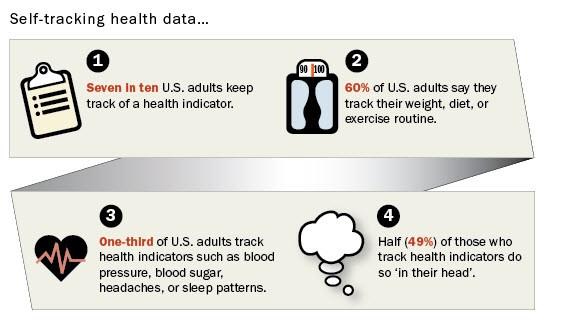
FoIB Holly R tips us to this Pew Research graphic, according to which we're making some strides:

 
Frankly, though, I have to call BS on at least some of this. My guess is that what's really happening is that "60% of US adults CLAIM they track..."

And, of course, "tracking" doesn't necessarily lead to "doing something about it."

Death Cab for Fatty

Looking for health insurance? Smokers and obese are paying more, and why not?

Annual health care costs are roughly $96 billion for smokers and $147 billion for the obese, the government says. These costs accompany sometimes heroic attempts to prolong lives, including surgery, chemotherapy and other measures.But despite these rescue attempts, smokers tend to die 10 years earlier on average, and the obese die five to 12 years prematurely, according to various researchers' estimates.
AP

Deadbeats pay more when they borrow money. Careless and dangerous drivers pay more for health insurance.

Why shouldn't those with unhealthy lifestyles pay more for health insurance?
Smoking has the most obvious impact. Studies have increasingly shown harm to nonsmokers who are unlucky enough to work or live around heavy smokers. And several studies have shown heart attacks and asthma attack rates fell in counties or cities that adopted big smoking bans.
The libertarian in me says we don't need more laws that impact personal freedom, but the capitalist side says that tobacco use is a choice and most obese people became overweight because of personal choice to overeat.

When you make a conscious choice to take on risky behavior you should expect to pay the price.